by Cary Osborne
The question of whether Fernando Valenzuela is a Hall of Famer is for a committee of 16 to answer on Sunday.
But there are those not on the committee — baseball heavyweights — who definitively say he is.
People like Dusty Baker, whose managerial career has put him on the road to Cooperstown.
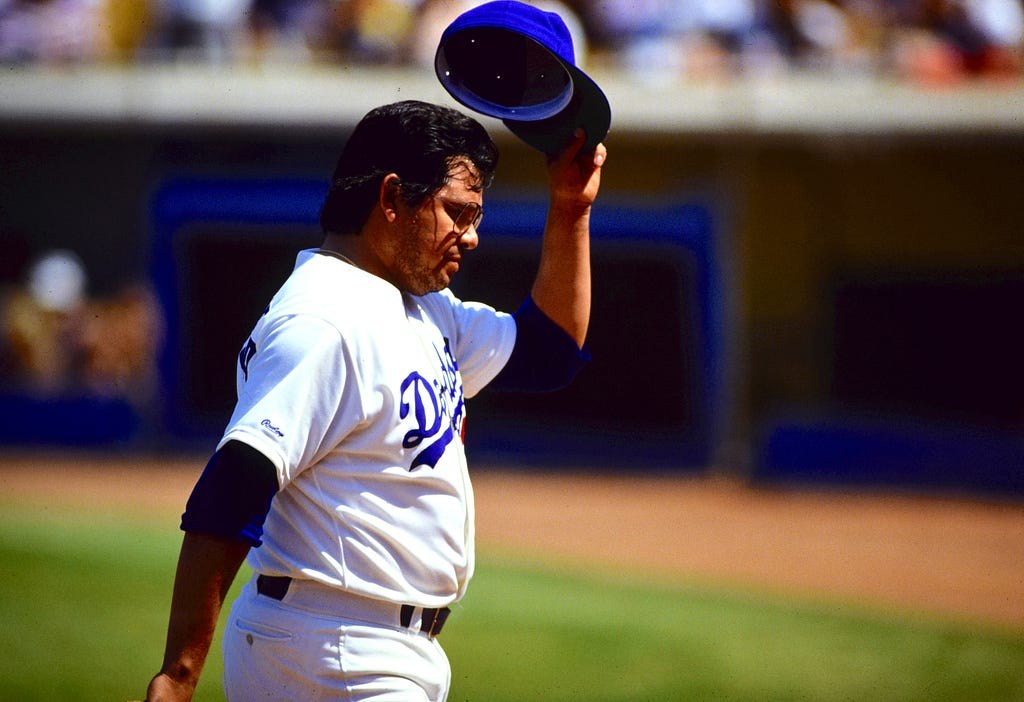
“Definitely, he should be a Hall of Famer,” Baker said.
Baker was in left field for the Dodgers at Atlanta-Fulton County Stadium when Valenzuela made his Major League debut on Sept. 15, 1980. And Baker was in the Dodger outfield for the first three full seasons of Valenzuela’s career.
“When he pitched, it was win day. You had the feeling, the fans had the feeling, and the opposing team had the feeling,” Baker said.
Yes, it was win day. Valenzuela’s 128 wins during the 1980s ranked fourth in the Major Leagues. He won five of his eight starts in the postseason. With the Dodgers on the brink of elimination in the 1981 NL Division Series, a 20-year-old Valenzuela pitched a complete game in a 2–1 win in Game 4.
And in the win-or-go-home Game 5 of the NL Championship Series, he recorded 26 of the Dodgers’ 27 outs in a 2–1 win in Montreal against the Expos.
Valenzuela’s ERA in the three postseason games the Dodgers didn’t win was 2.45.
“Fernando is a Hall of Famer for a number of reasons — not only the statistical achievements of his whole career, but the willingness he had to do anything that was needed during the course of a season or playoffs to help his team win. And he did it on many occasions,” said World Series champion player and manager Mike Scioscia. “If he needed to throw 160 pitches in a game, he would do it, and he would give all of his self to do it. He had the unique ability to put everything aside and focus on what the team needed.”
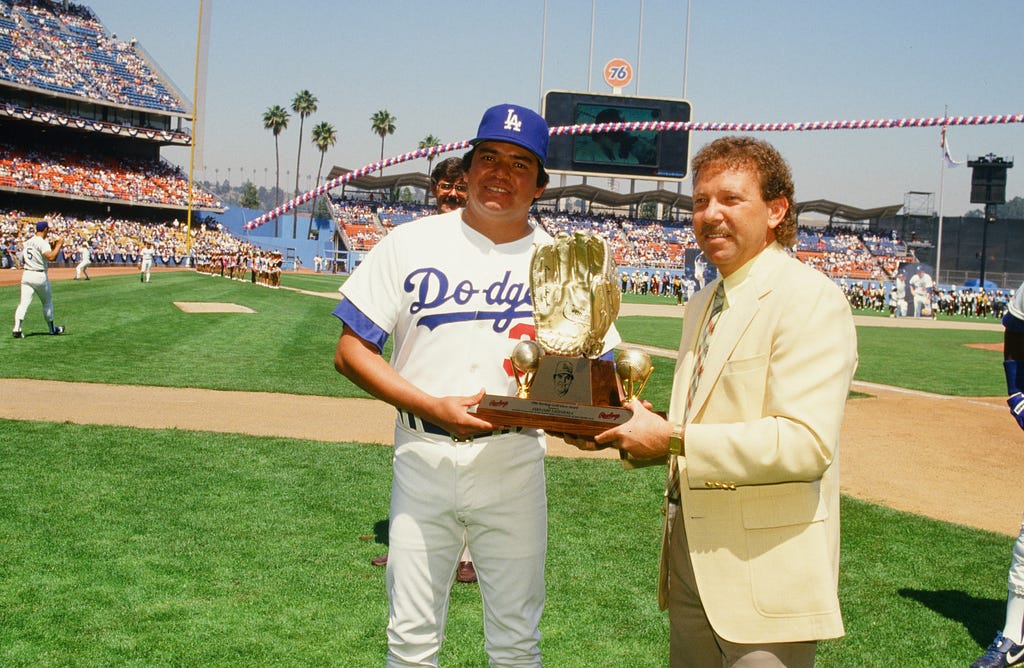

Scioscia caught Valenzuela in 245 regular-season games and seven postseason games. No one had a better seat for the 11 seasons Valenzuela pitched for the Dodgers. Scioscia caught the final six shutout innings of Valenzuela’s 147-pitch victory in Game 3 of the 1981 World Series, when the left-hander settled in after allowing four runs in the first three innings. Scioscia bookended that by catching Valenzuela’s no-hitter on June 29, 1990, against the Cardinals.
He’s right — Valenzuela was a workhorse. He threw 2,144 2/3 innings in the 1980s and completed 102 games. In 1986, Valenzuela completed 20 games — the last pitcher to reach 20 complete games in a season. Put the emphasis on last, as it will probably never happen again. He had six seasons with 250 innings pitched.
Scioscia, like others, will point out that with Valenzuela, it’s far more than numbers. Valenzuela made 255 consecutive starts over eight seasons until a shoulder injury knocked him out of action for two months late in the 1988 season. He wasn’t well enough to be on the postseason rosters for a World Series championship team.
Numbers declined. But his will to pitch didn’t. He spent most of 1991 in the Minor Leagues and all of 1992 pitching in the Mexican League, fighting for a chance to be a big leaguer again. The final five years of his Major League career were spent with four teams. He pitched 120 games, started 102 and had a 4.40 ERA.
“People get too caught up in ‘If we let this guy in (the Hall of Fame) with these numbers what’s going to happen?’” Scioscia said. “There is nobody who will have the impact on the game that he had that will come around in our lifetime.”
Valenzuela’s case is different than most.
His 1981 season created one of the most exciting periods in Dodger history. He also created a ripple effect on Major League Baseball that has spanned generations.
“There were great Mexican players in MLB prior to Fernando, but as a country, everybody was ‘Let’s watch,’ when he played,” said Adrián González, one of the greatest Mexican Major Leaguers in history. “What he did was create a movement for the country of Mexico to start watching and being invested in the Dodgers and MLB.
“I’m drawing comparisons the way he captured an audience to what Ohtani is doing because what he has done, the whole world is watching now.”
Eleven of Valenzuela’s 12 starts at Dodger Stadium in 1981 were sold out and attendance increased by an average of 9,000 fans whenever he pitched in road games.
He was a guest of President Ronald Reagan with Mexico President José López Portillo at the White House in 1981.
He is the greatest Mexican-born pitcher in Major League history — by numbers, achievements and influence.
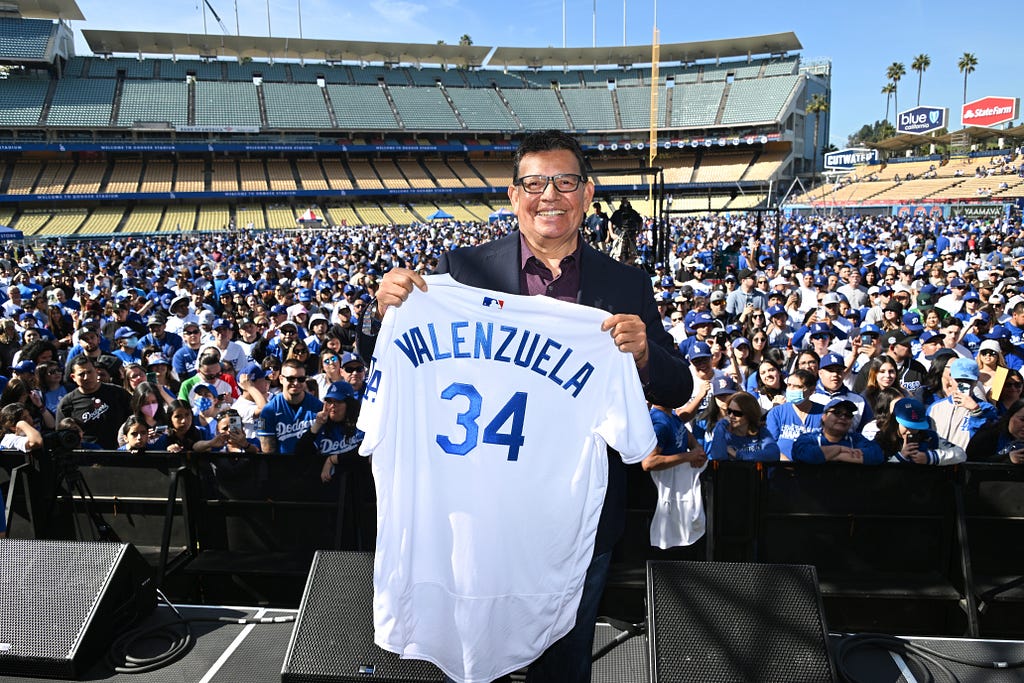
“Fernando’s legacy to me is that of Cuban Minnie Miñoso, another trailblazer,” said John Thorn, the official historian of Major League Baseball, as quoted in this 2024 MLB.com story. “The two of them are worthy candidates for the Hall of Fame if you do not use merely the stat lines as your criteria. They are ethnic heroes. They are culture heroes.”
Miñoso was elected to the Hall of Fame by the Golden Days Era Committee in 2021 and enshrined in 2022.
Search “Fernando Valenzuela” and “culture” or “Fernando Valenzuela” and “legacy” and a river of stories flows about how his excellence either created new fans or brought back fans to baseball — most notably Mexican/Latino fans.
It was mentioned in the May 4, 1981 edition of Sports Illustrated in an article titled “Epidemic of Fernando Fever.”
Sports Illustrated reported that for Valenzuela’s May 8, 1981 start in New York against the Mets, Venezuelan radio stations carrying the Dodgers’ Spanish-language broadcasts increased from 20 to 40 for the game, and the number of Mexican stations from three to 17.
From the same story:
“The Mets built two extra ticket booths near the subway entrances to accommodate the anticipated rush of fans. The crowd of 39,848 was the Mets’ largest of the season — they had been averaging 11,358 — and, according to one estimate, put an extra $310,000 in the club till.”
Valenzuela threw a shutout against the Mets that May 8.
He was far more than a one-year sensation.
In 1985, Valenzuela was on the cover of Sports Illustrated for a second time — those of previous generations will understand what a big deal that is.
Valenzuela had a 0.21 ERA through his first five starts of the season. That season, he had a 10-inning start, an 11-inning start, he completed 14 games out of 35 starts and he had a 2.45 ERA.
From 1981–1987, he had a 31.2 bWAR (Baseball Reference wins above replacement), was a six-time All-Star, the 1981 Cy Young Award winner and finished as a Cy Young Award finalist twice. FanGraphs gives a higher WAR at 34.2. The next best pitcher during the period was Nolan Ryan at 28.7.
Valenzuela — born and raised in tiny Etchohuaquila in Sonora, Mexico, signed out of Mexico as a teenager, thrust into action for the Dodgers on Opening Day 1981 barely out of his teenage years — grew into a baseball and cultural icon now depicted in more than a dozen murals in Los Angeles.
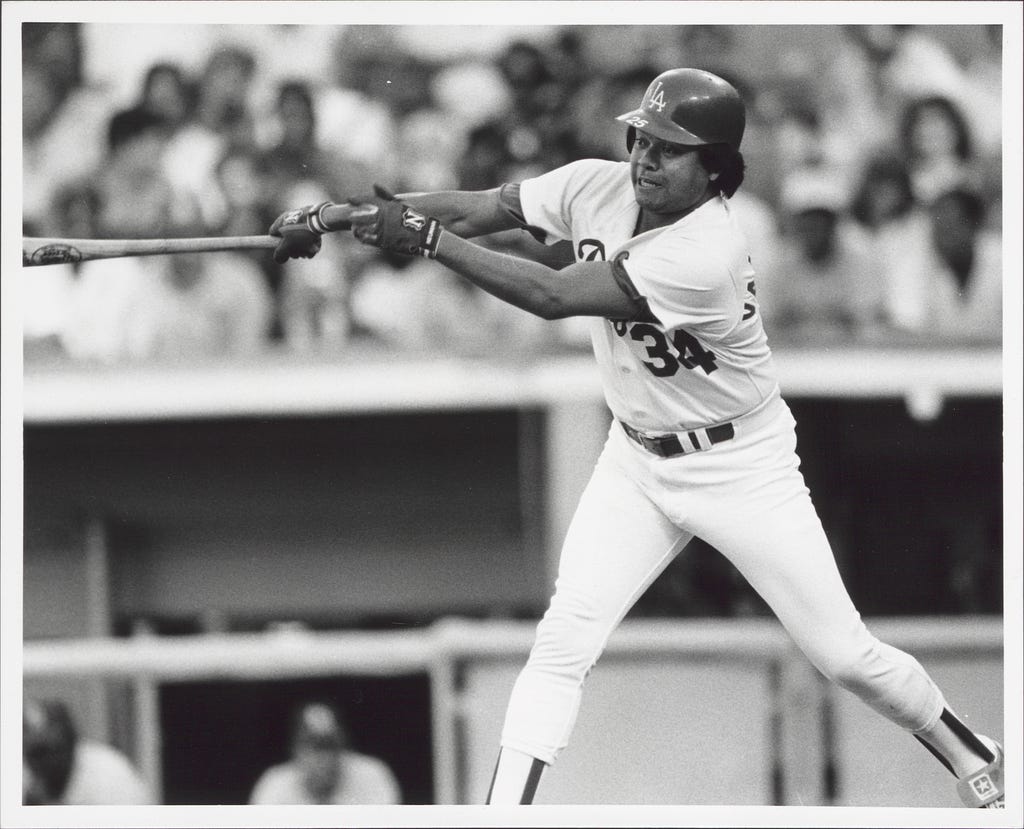
The Dodgers took the extraordinary step of retiring Valenzuela’s No. 34 — an honor that has been reserved for Hall of Famers — on Aug. 11, 2023. There was one exception prior to Valenzuela. The Dodgers retired Jim Gilliam’s No. 19 two days after he passed away at 49 years old in 1978. Gilliam, an All-Star infielder and coach for the generation of Dodgers who sparked Los Angeles to NL pennants in 1974, 1977 and 1978, was a beloved figure in the organization.
Valenzuela’s No. 34 was retired in the Mexican Baseball League in 2019.
Valenzuela was honored by the U.S. federal government in 2022 with the Outstanding Americans by Choice recognition. The initiative recognizes the outstanding achievements of naturalized U.S. citizens. The city of Los Angeles declared Aug. 11 Fernando Valenzuela Day on the morning that his No. 34 was retired by the Dodgers. Nov. 1 was declared Fernando Valenzuela Day in the state of California in 2025.

He was a Dodger Spanish-language broadcaster for two decades until he passed away on Oct. 22, 2024.
Baseball Commissioner Rob Manfred noted some of these significant post-playing contributions to the sport in a statement after Valenzuela passed away.
“Fernando was an outstanding ambassador for baseball. He consistently supported the growth of the game through the World Baseball Classic and at MLB events across his home country,” Manfred said. “As a member of the Dodger broadcasting team for more than 20 years, Fernando helped to reach a new generation of fans and cultivate their love of the game. Fernando will always remain a beloved figure in Dodger history and a special source of pride for the millions of Latino fans he inspired.”
But if it were all to come down to playing contributions, there are more arguments to make in favor of Valenzuela.
MLB.com writer and BBWAA member Manny Randhawa recently compared Valenzuela’s career favorably to Hall of Fame pitchers Jack Morris and Catfish Hunter.
Valenzuela has a better career ERA than Morris, CC Sabathia and Mike Mussina. He has a higher bWAR than Hunter. He has a better FIP (fielding independent pitching) than 13 Hall of Fame starters, including Morris and Tom Glavine.
Which leads to another point — the underrepresentation of Fernando’s era in the Hall.
Only five pitchers (four starting pitchers) whose careers began in the 1980s are in the Hall of Fame, the first three being mainly Atlanta pitchers — Greg Maddux, Glavine and John Smoltz — plus Randy Johnson and reliever Lee Smith.
No starting pitcher whose career began from 1978–1985 (eight seasons) is in the Hall of Fame. No other period in MLB history has this kind of gap, dating back to 1871.
Maybe that changes.
The Contemporary Baseball Era Committee will meet on Sunday at MLB’s Winter Meetings in Orlando, Fla. Valenzuela’s name is on their ballot.
Fernando Valenzuela’s unique case for Hall of Fame induction was originally published in Dodger Insider on Medium, where people are continuing the conversation by highlighting and responding to this story.