
by Mark Langill
The hottest current star in Southern California is the strong and silent type, while remaining at the center of attention in any location or setting.
After appearing onstage for the first time in Canada on November 1, the triumphant journey back to the United States has been a whirlwind celebration filled with bright lights, confetti, champagne toasts and seemingly daily photo shoots.
Yet nary a negative word has ever been heard from Major League Baseball’s shining symbol of greatness.
Usually surrounded by security and living life out of a suitcase — actually, a special protective case — there aren’t too many icons available to their fans at a moment’s notice.
Its given name is The Commissioner’s Trophy.
For the devoted supporters of the burgeoning Dodger empire, “back-to-back bling-bling” will suffice.
When the Dodgers pulled off a 5–4 victory in Game 7 of the World Series against the Blue Jays, the 11-inning thriller filled with enough drama to replay and savor for generations, the storybook didn’t officially close until the Dodgers first raised the trophy in front of the subdued home crowd at Toronto’s Rogers Centre.
It was the ninth World Series title in the history of the Brooklyn/Los Angeles franchise, and the first time the Dodgers won consecutive World Series championships.
The 2025 trophy has generated excitement when recently displayed at Lakers and Rams games, and it made a guest appearance on The Jimmy Kimmel Show with an entourage that included manager Dave Roberts and several Dodger players.
This winter, fans at Dodger Stadium will have opportunities to take a photo with the trophy as part of a special stadium tour package.
Overall, the Dodgers have five World Series trophies in their collection — 1981, 1988, 2020, 2024, and 2025 — the result of the sport’s evolution in how championships are commemorated.
MLB first awarded a World Series trophy to the 1967 Cardinals after St. Louis defeated the Boston Red Sox in seven games. Unlike other honors like the Cy Young Award, baseball didn’t name its championship trophy after a person. The World Series trophy eventually became The Commissioner’s Award in 1985.
Other major sports trophies include names on their ultimate prizes: Hall of Fame coach Vince Lombardi (National Football League’s Super Bowl trophy), governor general of Canada Frederick Stanley (National Hockey League’s Stanley Cup), and former commissioner Larry O’Brien (National Basketball Association’s championship team trophy).
Baseball’s tradition of celebrating titles originated with a “whip pennant” awarded to the champions of the first professional league — the 1871 Philadelphia Athletics of the National Association.
According to John Thorn, the Official Historian of Major League Baseball, the newly formed National League planned a similar symbol for its first champion.
The National League’s minutes of Feb. 2, 1876, designated the winning team to purchase a pennant to display at its ballpark:
“The emblem of the championship shall be a pennant (of the national colors), to cost not less than one hundred dollars ($100). It shall be inscribed with the motto, Champion Baseball Club of the United States, with the name of the club and the year in which the title was won; and the championship club shall be entitled to fly the pennant until the close of the ensuing season.”
The Brooklyn Dodgers won the National League “pennant” in 1890 — their first season in the NL, followed by successive titles in 1899 and 1900.
The American League was founded in 1901, and the first World Series was staged in 1903. World Series rings were awarded to members of the winning teams beginning in 1922.
Previous awards, commissioned by the teams or their supporters, dated back to the first postseason of 1884. The prizes usually resembled fine jewelry and varied from championship pins to watch fobs.
Between 1934 and 1998, Hillerich & Bradsby, manufacturer of the Louisville Slugger model bat, presented commemorative bats to players and club officials from each year’s participating World Series teams. The black bats had the players’ names engraved in gold into the dark wood; a “signature” similar to the one used on the bat barrel if the player was under contract to the company, or simple block letters for non-endorsed players to represent their place on the team.
Those bats turned into consolation prizes when the Dodgers lost five consecutive World Series against the New York Yankees between 1941 and 1953.
The Dodgers were late to the World Series parties, not winning a title until their eighth try in 1955. The Dodgers staged a World Series parade — their first and only in Brooklyn — and the concept didn’t immediately catch on in Southern California.
When the Dodgers moved to the West Coast in 1958, an Opening Day parade before an afternoon game against the newly minted San Francisco Giants led to the Los Angeles Memorial Coliseum, the team’s temporary home during the construction of Dodger Stadium. The Giants, who had also relocated from New York, held a similar welcome parade for their new fan base.
The Dodgers and the City of Los Angeles didn’t stage World Series parades in 1959, 1963 and 1965.
The traditional unveiling of the championship “pennant” occurred during the following season’s home openers in 1956 at Brooklyn’s Ebbets Field, in 1960 at the Coliseum, and in 1964 and 1966 at Dodger Stadium.
In 1981, the Dodgers’ first World Series trophy coincided with their first Los Angeles World Series parade.

The Dodgers received their first World Series trophy in the visitors’ locker room at New York’s Yankee Stadium after a 9–2 victory in Game 6 of the Fall Classic.
The 1981 trophy ceremony was much different from today’s choreographed on-field presentation that Major League Baseball began in 2017.
The current World Series wrap-up program features the winning team’s owner receiving the award. Within a few moments, the trophy is held high in the air.
In 1981, there was happy postgame confusion in the Dodger clubhouse as ABC television broadcaster Bob Uecker and Commissioner Bowie Kuhn bantered on air while waiting for manager Tommy Lasorda, team president Peter O’Malley and general manager Al Campanis to step into a small podium.
While awaiting the clubhouse arrivals of O’Malley and Campanis, Lasorda expressed his initial thanks and stepped off stage and back into the celebration.
When the trio was finally assembled, Kuhn started his speech.
Meanwhile, Dodger outfielder Pedro Guerrero and first baseman Steve Garvey started pouring champagne on Lasorda, who was standing to the far left of Kuhn, Campanis and O’Malley.
Kuhn briefly paused as public relations director Steve Brener handed Lasorda a towel. Then outfielder Jay Johnstone subtly poured champagne on Kuhn, Campanis and O’Malley, all formally dressed in suits and ties.
Kuhn said he was happy to present the World Series trophy to the Dodger organization.
But the trophy, located a few feet away, never moved. It remained perched on a small table to Lasorda’s right, resting on a red-colored base and guarded by the watchful eye of Ed Stack, the president of the Baseball Hall of Fame.
During the 1981 World Series parade, two members of the Dodger publicity department — Steve Ross and Robert Schweppe — oversaw holding the trophy as the series of decorated floats made its way through the streets of downtown Los Angeles before a rally at City Hall. Their respective low profiles of Ross and Schweppe suddenly elevated when the pair raised the trophy into the air to the cheers and delight of the crowd.
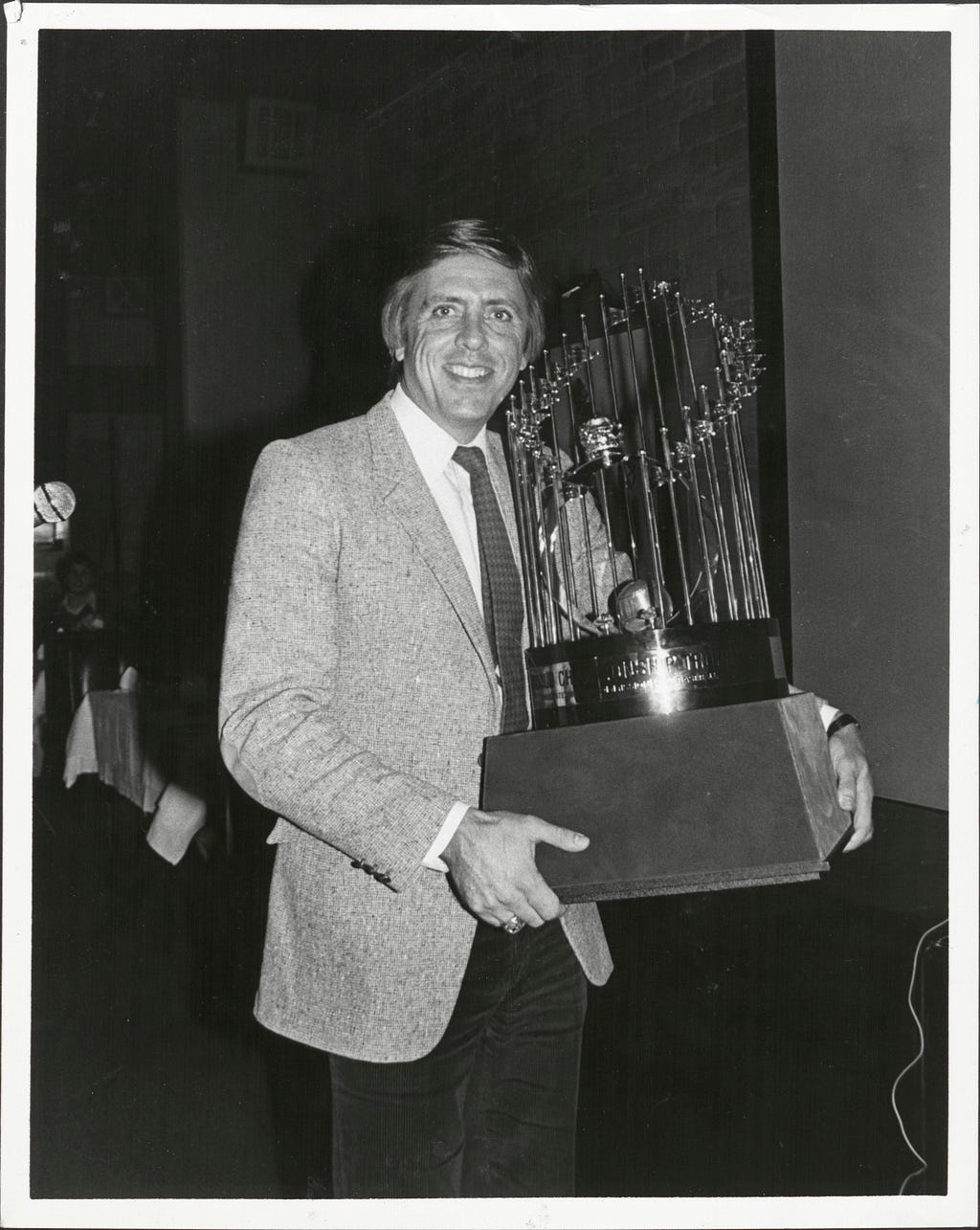
The Dodgers became the only Major League team during the 1980s to win two World Series.
In 1988, Baseball Commissioner Peter Ueberroth presented the World Series trophy to O’Malley, Lasorda and general manager Fred Claire after the Dodgers’ 5–2 victory over the Athletics in Game 5 at Oakland.
The Dodgers originally displayed their 1981 and 1988 World Series trophies inside a glass case in the lobby of the executive offices on the Club Level at Dodger Stadium.
The five World Series trophies are now part of an awards display in the hallway between the elevator behind home plate and the entrance to the Dugout Club at Dodger Stadium.

A history of Dodger blue with gold trophies was originally published in Dodger Insider on Medium, where people are continuing the conversation by highlighting and responding to this story.