
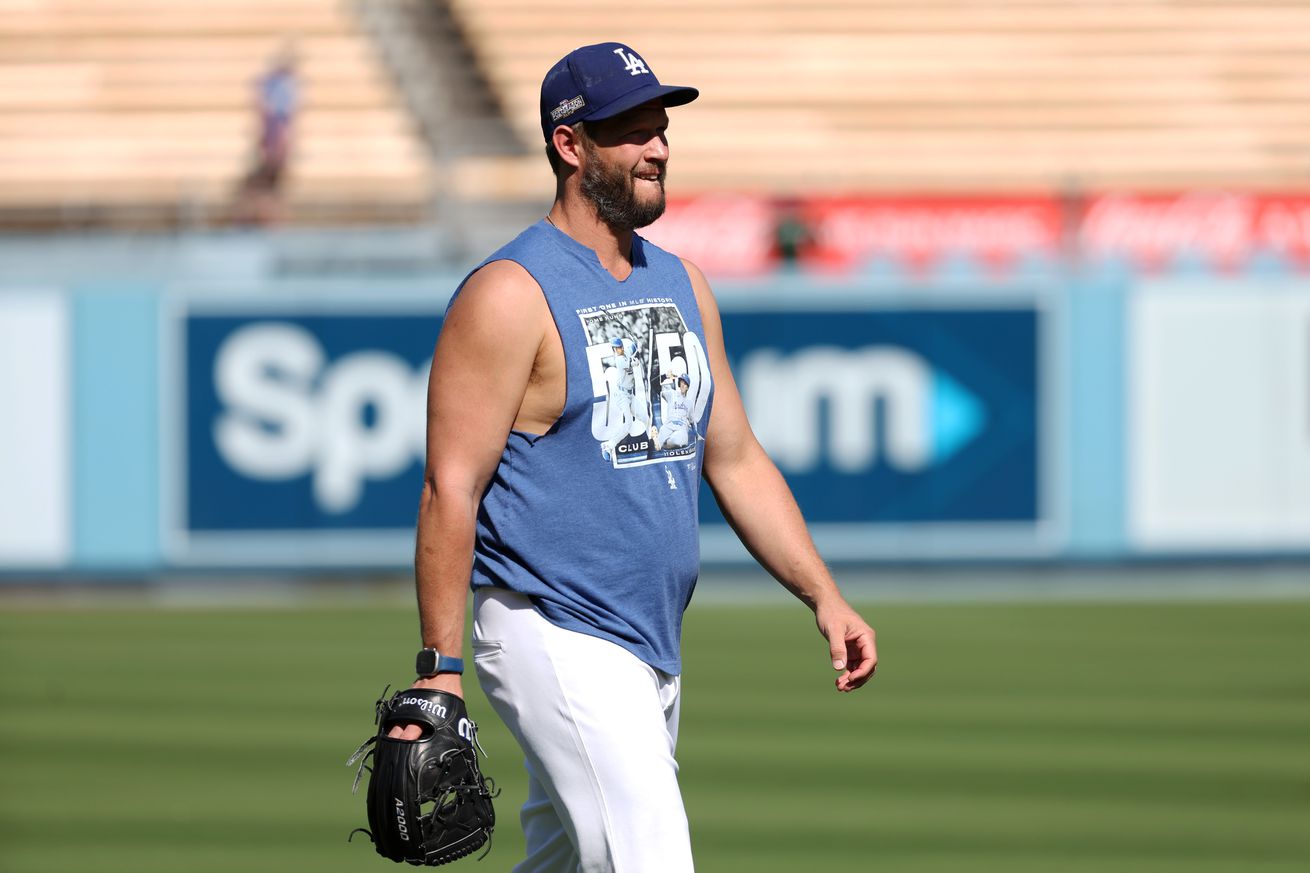
More on Kershaw’s return to Dodgers in 2025 as well as his big toe injury, plus Muncy on LA’s approach on offense this October
What we do know after Monday’s announcement by Clayton Kershaw that he will return to pitch in 2025 is that will be for the Dodgers. What is still to be decided is whether Kershaw will exercise his $10 million player option (which has up to $15 million more in incentives) or work out a new deal.
There’s also the matter of whether the bone spur and inflammation in his left big toe will require surgery, and whether Kershaw will be available to pitch a full season at age 37 next year.
From Bill Plunkett at the Orange County Register:
“It’s not, like, super clear-cut,” he said. “But I think we’re getting a pretty decent plan together in place. Whatever happens, it can wait until after this run here.”
Whether he is available to pitch a full season in 2025 is “another discussion,” he said he would have with Friedman.
“I think it’s all worth figuring out with Andrew after the season,” Kershaw said. “I don’t know if a full season is in the cards necessarily, but it might be. I just, I don’t know yet. Got to figure it out.”
Max Muncy was a guest on Foul Territory on Wednesday morning, and among other things — like comparing Shohei Ohtani to a create-a-player in a video game — talked about the Dodgers’ collective approach offensively this October compared to the past few postseasons.
“Understanding that taking too many good pitches to hit, then on the flip side of that, because you’re trying to null that, you’re swing at too many pitches out of the zone,” Muncy said. “We just got back to being us, something we’ve done all year long. Control the strike zone, when it’s in there, hammer it, and when it’s not in there you take it. Sometimes it’s called a strike and sometimes it doesn’t. It’s just really looking for your pitch to hit, and that’s something we’ve zoned in on this postseason.”
Muncy has reached base in each of his last eight plate appearances, including five times Wednesday night. He’s the all-time franchise postseason leader in both walks and home runs now.
The Dodgers as a team are averaging 5.5 runs per game this postseason, and have scored at least five runs in five of their eight games.
Sam Blum at The Athletic talked to several baseball announcers about the practice of teams’ regular season television broadcast crews don’t call that team’s postseason games unless they switch to radio, since all MLB postseason are on national TV.
The Dodgers this year are in a unique position that their lead TV broadcaster Joe Davis is also the No. 1 baseball announcer at Fox Sports and because Fox has the NL side this year and the No. 1 crew was assigned to Dodgers-Padres, Davis will call every Dodgers postseason game this season, too.
“Your connection with the broadcasters is stronger than any other sport because there’s 162,” said Joe Davis, the Dodgers broadcaster who also calls the playoffs, including the World Series, on FOX. “Just about all of them you’re spending with the two guys that are with the team.”
“And then, who are these people who show up and call the biggest games of the year? I totally get it. You’re never going to be the most popular guy in the room in that role.”
Stephen Nelson, who called 59 Dodgers games this season on SportsNet LA (Davis called the other 87 on the network) plus 40 more games on radio, is calling every Dodgers game locally on AM 570 radio, which puts the Dodgers this year in the unique position of having their two lead TV play-by-play announcers still calling games this October.
Charter Communications, which runs Spectrum and both SportsNet LA and Access SportsNet, is eliminating a few positions and cutting back on programming on those networks, per Bill Shaikin and Jack Harris of the Los Angeles Times:
Live coverage of the Dodgers and Lakers games is not expected to be affected. Instead, Charter is canceling “Behind the Sport” and reducing new episodes of “Backstage: Dodgers” and “Backstage: Lakers” to one per month, according to company spokeswoman Maureen Huff.